China’s cheap open source AI models are outpacing America’s closed guard
07/27/2026 / By Lance D Johnson

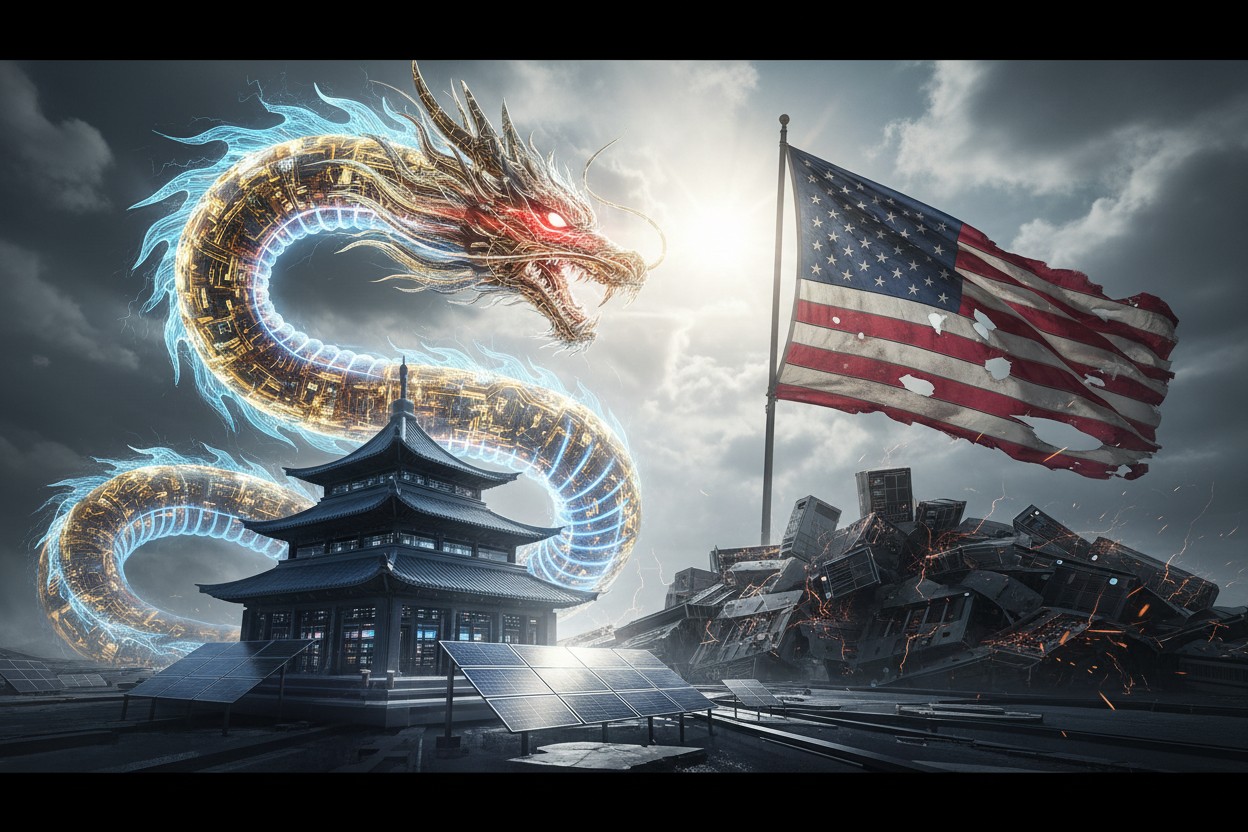
The artificial intelligence race has taken a stunning turn that the corporate media refuses to frame honestly. China is not just catching up to the United States in AI, it is actively winning across 37 of 44 critical technologies, with open source models that are cheaper, more transparent and often smarter than America’s proprietary giants. While the U.S. government pours billions into closed systems at OpenAI and Oracle, Beijing’s approach of releasing free, open models is creating a tidal wave of global adoption that no amount of sanctions can stop. The evidence is now undeniable from Silicon Valley to Shanghai: the future of AI belongs to those who share, not hoard.
Key points:
- China leads in 37 of 44 key technologies including AI, advanced materials and high performance computing.
- DeepSeek’s R1 reasoning model cost less than $5 million to train yet outperforms OpenAI and Google in logical reasoning.
- Chinese models like Kimi K3 and GLM 5.2 are now preferred by American tech executives for daily tasks.
- Open source Chinese AI models are nearly as intelligent as closed models from Anthropic and OpenAI.
- U.S. sanctions on American AI models are creating openings for Chinese competitors.
- Chinese AI prices can be hundreds of times cheaper than American models for equivalent performance.
The open source revolution that Washington cannot stop
The story of China’s AI ascent is not about espionage or distillation fantasies peddled by corporate lobbyists. It is about a fundamentally different philosophy of technology development. While American companies like OpenAI and Anthropic lock their frontier models behind paywalls and proprietary controls, Chinese startups including DeepSeek, Moonshot and Z.ai release their best models as open source for anyone to inspect, modify and build upon.
This approach is resonating with practical users. Raffi Krikorian, the chief technology officer at Mozilla, told the Associated Press that he switched to Kimi K3 from Moonshot within days of its launch, describing the Chinese chatbot as “snappier” than the acclaimed but more expensive Claude Fable from Anthropic. The same pattern is repeating across the American tech landscape. Coinbase recently announced it is switching to Chinese AI models to cut costs. North Carolina technology executive Curt Meinhold said he prefers DeepSeek for finding business leads and generating sales, noting that most users do not need the premium American models.
The cost comparison is staggering. U.S. AI models charge up to $50 per million tokens for output, while Chinese alternatives cost a handful of cents for equivalent performance. As AI agents begin handling complex multi-step tasks autonomously, these cost differentials compound dramatically.
Why DeepSeek is outperforming its American rivals
DeepSeek’s R1 reasoning model represents a paradigm shift in AI development. Trained for under $5 million in compute costs, it outperforms OpenAI’s GPT models and Google’s Gemini in logical reasoning benchmarks. The model demonstrates that expensive hardware and massive corporate budgets are not prerequisites for superior intelligence.
The leading models competing in this space include OpenAI’s GPT 4 and upcoming GPT 5, Anthropic’s Fable and Mythos, Google’s Gemini, Meta’s Llama, and the Chinese cohort of DeepSeek’s V4, Moonshot’s Kimi K3, Z.ai’s GLM 5.2, and Alibaba’s Qwen3.8 Max. Among these, DeepSeek’s advantage lies in its efficiency. It achieves frontier level reasoning without the massive energy consumption and hardware requirements of its American counterparts. This efficiency comes from architectural innovations that maximize performance per watt and per dollar.
Moreover, DeepSeek’s decision-making processes are more transparent because the model is open source. Researchers and developers can examine exactly how it arrives at conclusions, something impossible with closed models from OpenAI. This transparency builds trust and enables rapid community driven improvements that proprietary systems cannot match.
Chinese models still lag slightly in overall full range capabilities, according to Anastasios Angelopoulos, co founder of AI evaluation platform Arena. But the gap is narrowing with each release cycle. The top five most popular models on OpenRouter are now all Chinese. Kimi K3 generated 930,000 downloads in its first week, a 200% increase from the previous week. U.S. downloads surged 387%.
The Trump administration’s response has been counterproductive. By restricting American models like Anthropic’s Fable and Mythos from export for weeks, it created openings that Chinese competitors immediately filled. Mozilla’s Krikorian noted that “the open frontier is becoming increasingly Chinese built.” The lesson is clear: restriction breeds replacement, while openness breeds adoption. If the world catches on and more people migrate to adopting Chinese AI models, then the AI bubble in the West will burst and AI stocks could come crashing down.
Sources include:
Submit a correction >>
Tagged Under:
affordable intelligence, AI disruption, AI race, AI transparency, American AI decline, Anthropic rivals, Big Tech, China, China leads., Chinese innovation, cost efficient AI, Deepseek R1, glitch, global AI adoption, Moonshot Kimi, open frontier, open-source AI, OpenAI alternatives, reasoning models, sanctions failure, tech giants, tech policy, technocrats, technology competition
This article may contain statements that reflect the opinion of the author
RECENT NEWS & ARTICLES