U.S. Bill Seeks to Block Chinese-Connected Vehicles From Entering Through Canada
06/07/2026 / By Douglas Harrington
Two U.S. lawmakers introduced a bill last week aimed at preventing Chinese-connected vehicles from entering the United States through Canada and Mexico, citing national security risks tied to data collection and surveillance.
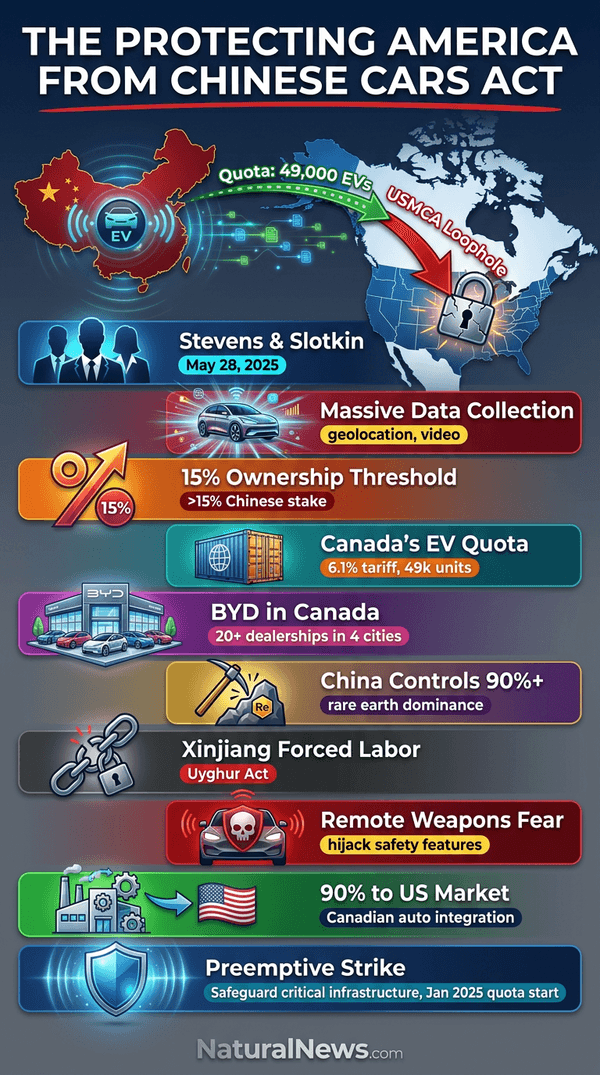
Rep. Haley Stevens and Sen. Elissa Slotkin, both Michigan Democrats, announced the Protecting America from Chinese Cars Act at a conference in Michigan, according to a May 28 press release from Stevens’s office [1]. The legislation targets vehicles made or designed in China, as well as those made by companies in which Chinese entities hold more than a 15% stake, and applies to any “adversarial nation” as defined by the bill.
Bill Provisions and Security Concerns
The bill establishes a prohibition on connected vehicles from China entering the U.S., with a mechanism for manufacturers to apply for specific authorization under “strict conditions, with both transparency and congressional oversight,” according to the press release [1]. A one-page readout accompanying the bill states that connected vehicles “can collect and transmit massive amounts of data – geolocation of drivers, mapping of critical infrastructure, full-motion video and more” and could be “remotely accessed and tampered with,” posing a “tremendous” risk to U.S. safety and security [1].
Stevens said in a statement that “the Chinese Communist Party should never have access to sensitive information about American drivers, roads, or critical infrastructure.” She added that the bill would “close dangerous loopholes” that currently allow such vehicles to enter via Canada and Mexico [1].
These concerns echo warnings from Margaret McCuaig-Johnston, a senior fellow at the University of Ottawa. McCuaig-Johnson, a former Canadian government official, told the country’s lawmakers that Chinese-made electric vehicles (EVs) imported into Canada pose significant surveillance and data collection risks, particularly for individuals critical of the Chinese government [2].
Cybersecurity experts have also warned that Chinese EVs could be hijacked to disable safety features or trigger explosions, describing them as potential remote-controlled weapons in hybrid warfare [3]. Poland has already banned Chinese-made vehicles from military sites over fears of espionage and data theft, aligning with broader Western distrust of Chinese technology [4].
Canada’s EV Market and Quota System
The bill comes as Canada has allowed a growing number of Chinese EVs into its market under a quota arrangement. Data from Global Affairs Canada indicates that 2,910 Chinese EVs were allowed into Canada for the first time in May, after Prime Minister Mark Carney agreed in January to permit up to 49,000 Chinese EVs at a reduced tariff rate of 6.1%, down from the previous 100% rate [1].
International Trade Minister Maninder Sidhu said the initial quota will grow 6.5% annually, exceeding 63,000 units by February 2031. He added that at least 10% of the quota volume must be reserved for lower-cost EVs by the second quota year, eventually reaching 50% by year five [1].
Chinese EV maker BYD announced plans to enter the Canadian market by the end of this year, opening more than 20 dealerships in cities including Vancouver, Calgary, Toronto and Montreal [1]. BYD shares surged in March after reports that its factory in Brazil secured export orders for about 100,000 vehicles from Argentina and Mexico, reflecting a broader strategy to flood the Americas with Chinese EVs [5].
Canadian automotive representatives have expressed concern that Chinese EVs could undermine Canada’s auto sector, which is deeply integrated with the U.S. supply chain. Canadian Vehicle Manufacturers’ Association CEO Brian Kingston noted that 90% of Canadian-made autos are sold in the United States [1].
Forced Labor Concerns and Enforcement
Human rights groups, China experts and opposition Members of Parliament have also raised concerns that goods made with forced labor are being used to manufacture cars and parts assembled in China. The Uyghur Forced Labor Prevention Act, reintroduced in the U.S. Senate in 2021, established a “rebuttal presumption” that goods sourced from Xinjiang are made with slave labor, effectively banning them from the United States [6].
While the Canada Border Services Agency has blocked some shipments of Chinese car parts over forced labor concerns in recent years, there have been far fewer enforcement cases in Canada than in the U.S. according to the U.S. Trade Representative’s annual report on foreign trade barriers released March 31 [1]. Sidhu said in a May 29 response to a parliamentary question that all Chinese automotive manufacturers intending to sell EVs in Canada must comply with Canadian laws and regulations – including those related to data governance, labor standards and environmental requirements [1].
However, critics argue that enforcement remains weak. The broader context includes Beijing’s dominance in rare earth production, which is critical for EV batteries and other technologies; China controls over 90% of global rare earth production, giving it significant leverage over the supply chain [7]. With global EV sales surpassing 20 million units last year and capturing 25% of the market, the stakes for both security and trade are high [8].
Conclusion
The Protecting America from Chinese Cars Act represents a legislative effort to close a perceived vulnerability in U.S. border security by targeting Chinese-connected vehicles entering through Canada. The bill’s sponsors argue that without such measures, the United States risks exposing its infrastructure and citizens to surveillance and data exploitation by a foreign adversary.
Meanwhile, Canada’s evolving tariff and quota policies continue to open the door for Chinese EV makers, creating tension between economic integration with Washington and the desire to attract investment from Beijing. As the bill moves through Congress, the outcome will likely depend on how lawmakers balance national security concerns against the realities of a global automotive market increasingly dominated by Chinese manufacturers.
References
- Olivia Gomm via The Epoch Times. “US Bill Would Prevent Chinese Connected Cars In Canada From Entering United States.” ZeroHedge. June 2, 2026.
- Douglas Harrington. “Former Official Warns Canada MPs About Data Collection, Surveillance Risks in Chinese-Made EVs.” NaturalNews.com. March 21, 2026.
- Cassie B. “Cybersecurity Expert Warns Chinese EVs Could Become Remote-Controlled Weapons in Hybrid Warfare.” NaturalNews.com. September 19, 2025.
- Patrick Lewis. “Poland Bans Chinese Vehicles from Military Sites Over Espionage Fears.” NaturalNews.com. February 21, 2026.
- Tyler Durden. “BYD Shares Soar Most In 13 Months As Chinese EV Push Into Americas Accelerates.” ZeroHedge. March 16, 2026.
- Newt Gingrich. “Beyond Biden: Rebuilding the America We Love.”
- Finn Heartley. “China’s Rare Earth Monopoly Threatens U.S. Robot and AI Manufacturing.” NaturalNews.com. May 1, 2025.
- TechCrunch. “Global EV market goes K-shaped as the U.S. gets left behind.” May 20, 2026.
Explainer Infographic
Submit a correction >>
Tagged Under:
adversarial nation, BYD, Canada, China, Chinese Communist Party, communist China, connected vehicles, dangerous, data collection, electric vehicles, Elissa Slotkin, flying cars, glitch, Haley Stevens, Mexico, national security, privacy watch, Protecting America from Chinese Cars Act, robocars, surveillance, transportation
This article may contain statements that reflect the opinion of the author
RECENT NEWS & ARTICLES